
Why Having a Hose Service Partner Matters Before an Emergency Happens
A hydraulic hose failure rarely checks the production schedule before causing trouble.
It can happen during the busiest shift, in the middle of an important job, or when the maintenance team is already stretched thin.
Once equipment stops, the search begins for the right hose, the correct fittings, and someone who can make the repair quickly.
That is not the ideal time to start looking for a dependable hose service company.
Building a relationship with a hose service partner before an emergency happens can help your team respond faster, reduce confusion, and get equipment back into operation with fewer delays.
Your Hose Service Partner Already Knows Your Facility
Every facility has different equipment, applications, operating pressures, hose sizes, fittings, and working conditions.
A hose service provider who has already visited your location may be familiar with:
The equipment you operate
Common hose and fitting requirements
Critical production areas
Facility access and safety procedures
The people responsible for approving repairs
Potential problem areas that deserve closer attention
That familiarity can save valuable time when a hose suddenly fails. Instead of beginning every emergency with introductions, directions, and explanations, your service partner can arrive with a better understanding of what may be needed.
Faster Response Starts Before the Breakdown
Quick repairs are not only about how fast a technician can arrive. They also depend on how quickly the problem can be identified and the correct replacement can be produced.
Before an emergency, a hose service partner can help document important information such as hose dimensions, pressure requirements, fitting styles, equipment locations, and replacement history.
This information can help reduce guesswork when every minute matters.
Having a clear point of contact also prevents employees from scrambling through online searches or calling several companies while equipment remains out of service.
Planned Shutdowns Create an Opportunity to Inspect Equipment
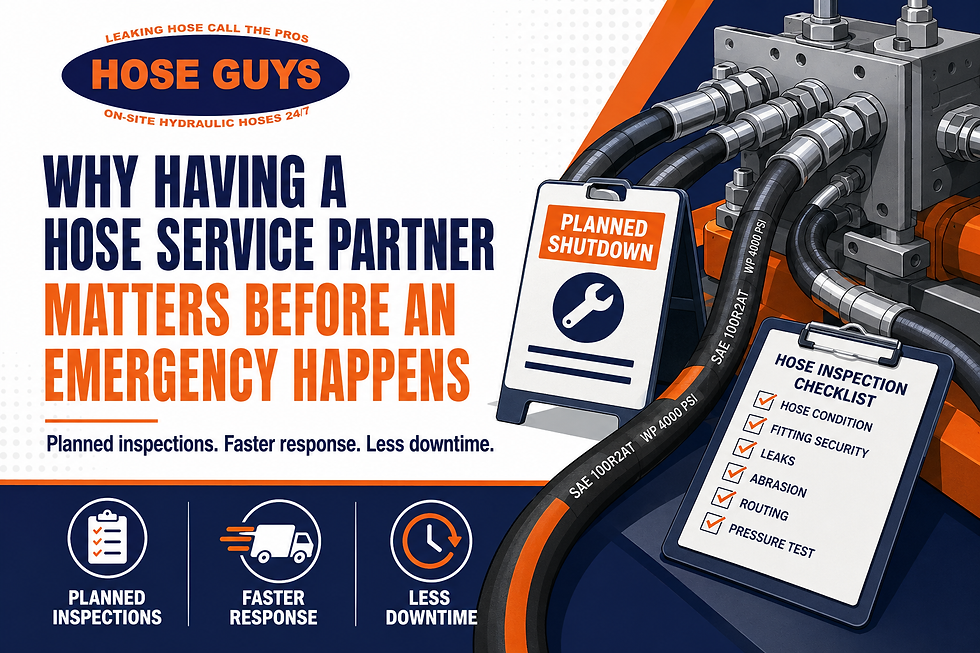
Planned shutdowns are not only for major maintenance and repairs. They are also a valuable opportunity to inspect hydraulic hoses while equipment is safely offline and easier to access.
During normal production, some hoses may be difficult to closely inspect. Guards, movement, heat, pressure, and limited access can make it harder to spot wear before it becomes a problem.
A hose service partner can use a planned shutdown to inspect hoses, fittings, routing, and connection points throughout the facility.
The inspection may uncover:
Cracking or dry rot
Abrasion from rubbing against equipment
Leaks around fittings
Exposed reinforcement
Kinks or tight bends
Heat damage
Loose or damaged connections
Hoses that are stretched, twisted, or poorly routed
Components that have reached the end of their useful life
Hoses showing signs of wear can often be replaced during the scheduled downtime instead of failing unexpectedly during production.
This helps turn a planned shutdown into a preventive maintenance opportunity rather than simply a pause in operations.
Planned Inspections Can Help Prioritize Repairs
Not every hose showing wear requires the same level of urgency.
During a planned inspection, a hose service partner can help identify which hoses should be replaced immediately, which ones should be closely monitored, and which replacements should be added to an upcoming maintenance schedule.
This allows the facility to prioritize repairs based on safety, condition, and production risk.
It can also help maintenance teams budget for replacements instead of facing several unexpected repair costs at once.
The Right Hose Matters
A hydraulic hose is not simply a piece of rubber with fittings attached.
The replacement must be appropriate for the equipment, fluid, pressure, temperature, movement, and environment. Installing the wrong hose or fitting can result in leaks, poor performance, premature failure, equipment damage, or serious safety hazards.
A dependable hose service partner can help ensure the replacement is properly matched to the application instead of relying on whatever happens to be available.
The goal is not simply to get the machine running again. It is to get it running safely and reliably.
A Partner Can Help Identify Problems Before They Become Emergencies
Some hose failures happen suddenly, but many begin with visible warning signs.
Cracking, abrasion, exposed reinforcement, leaks, damaged fittings, tight bends, poor routing, and excessive movement can all indicate that a hose needs attention. Routine inspections from an experienced hose professional may help identify these issues before they shut down production.
A service partner may also notice patterns, such as a hose that fails repeatedly in the same location. That could point to a routing problem, excessive vibration, heat exposure, incorrect hose selection, or another condition that should be corrected.
Replacing the hose may solve the immediate problem.
Finding out why it keeps failing can prevent the next one.
Better Emergency Inventory Decisions
Keeping replacement hoses and fittings onsite can be helpful, but stocking every possible combination is rarely practical.
A hose service partner can help determine which hoses are most critical to your operation and which replacements may be worth keeping in inventory.
This can help your facility avoid two expensive problems:
Not having the hose you need during a shutdown
Spending money on parts that may never be used
A more focused inventory gives your maintenance team access to the most important replacement components without turning the storeroom into a fitting museum.
Clearer Communication During High-Pressure Situations
Equipment failures can create pressure throughout an entire facility.
Production is waiting. Maintenance is troubleshooting. Supervisors want updates. Customers may be affected.
Everyone wants to know when the equipment will be running again. An established hose service partner gives your team a clear process and a familiar contact.
Your employees know who to call, what information to provide, and what to expect next. That structure can make an emergency easier to manage and reduce delays caused by confusion.
Service History Can Reveal Useful Patterns

Working with the same hose service provider over time can create a clearer record of repairs, inspections, and replacements.
That history may help identify:
Hoses that are failing more often than expected
Equipment that needs additional inspection
Areas with recurring abrasion or heat exposure
Parts that should be stocked onsite
Opportunities to standardize hoses and fittings
Repairs that can be scheduled during the next planned shutdown
Repair history turns individual service calls into useful maintenance information. Instead of treating every failure as an isolated event, your facility can begin making better long-term decisions.
A Service Partner Is More Than an Emergency Phone Number
The best time to choose a hose service company is when the equipment is still running.
A dependable partner can help with onsite evaluations, planned shutdown inspections, replacement hose fabrication, preventive maintenance, emergency planning, inventory recommendations, and troubleshooting recurring hose problems.
When a failure does happen, your team is not calling a stranger and hoping for the best.
You already have a trusted resource who understands your operation and is prepared to help.
Prepare Before the Pressure Is On
Hydraulic hose failures may not always be preventable, but the confusion surrounding them can be reduced.
Building a relationship with a hose service partner before an emergency gives your facility a stronger plan, a faster path to repair, and greater confidence when equipment goes down.
Planned shutdowns provide the opportunity to inspect equipment, replace worn hoses, document critical components, and prepare for future needs before production resumes.
The Hose Guys provide onsite hose service and support to help industrial facilities reduce downtime, address hose problems, and prepare for unexpected failures.
Do not wait until a failed hose brings production to a stop. Build the relationship, inspect the equipment, and make the plan before the pressure is on.


Comments